In this long journey following medical negligence and the resulting trauma that I live with, successes can be few and far between, but at the moment, I feel both joyful and tearful all at once because one of those successes is finally happening.
For a vast majority of Adam’s life, I have often said that I wish there was some kind of metaphorical big red sticker on his and my medical records that offers a short sharp warning to any clinician saying we are an “Ockenden family” whose lives have been forever changed by medical negligence and harm.
Adam and I have so many medical appointments with multiple hospital consultants, therapists, community nurses, and GPs among many others. Most of these have no idea about our background or why we have been referred to them and it is immensely disheartening to be faced with a new clinician who has a blank piece of paper in front of them and opens with, “So tell me, was Adam born at full term? Was the labour and delivery natural? Did he meet his milestones on time?” Many of these questions are perfectly routine and would be normal for an “average” parent to answer, but in my case, this means revisiting some of the darkest times in my life and rehashing them in front of yet another stranger, while also being forced to trust their medical judgement in whatever speciality they practice. For this reason, I have often wanted the equivalent of a big red traffic light warning that effectively says, stop! This family have been through enough so don’t say anything stupid that will make things worse! (Albeit in rather more professional wording).
Over the last three years, I have been repeatedly saying this in meetings with Donna Ockenden and senior executives at the Shrewsbury and Telford Hospitals and while the idea has been openly received, I have also heard that to create such an alert on electronic records would be rather more complicated than it might seem at the outset. It’s one thing to obtain permission to place such an alert on a patient’s hospital record at a local level, but quite another to roll out such an alert that would be visible to GP surgeries, community medical staff and even appear on national records.
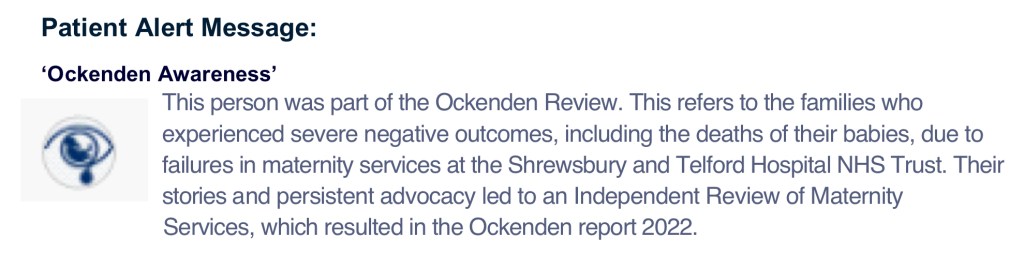
However, to their credit, they have worked together with another parent and finally succeeded in creating just such an alert for us both; in due course, this will be rolled out to other similarly affected families who wish it. So now, having signed all the required consent forms, when I open my NHS app, I can see an alert that immediately flags that I am part of a family who has suffered severe, lifelong harm, and that any conversations with clinicians must bear this in mind. There are still a few “niggles” to ensure it’s smooth roll out, and just today I was able to participate in a meeting with one of the hospital staff to a few concerns I had the first draft of wording and where in the NHS app this would be located, but it’s finally there. (For clarity: My issue with the wording that can be seen in the image below, is that 220 babies died, but there were also 94 children, like Adam, left with avoidable disabilities and 9 mothers who died, while others were left with lifelong harm. I believe it is very important not to focus on one at the cost of the others because all of our stories matter, so I have asked them to amend this.)
I have also asked them to attach a physical sticker to the paper records and have a system for times when I am admitted to hospital so that a suitable symbol or flag would also be added to the essential information board that is fixed to the wall behind a patient’s head (these typically include the patients name, dietary information, and essential alerts) and they have agreed to work on this as well.
Of course, it remains true that I wish such an alert wasn’t necessary because I would rather not be in this situation at all, but that is wishful thinking. The fact that I am in the situation, means I am both relieved and also tearful that work has been done so this alert has now been created. Sometimes, you can’t undo the root cause of a situation, but at least being able to manage it to ensure a trauma informed response is possible going forward, is still a win. So today, I’m celebrating a win and grateful to the parent who worked with the hospital to develop this idea.
 Life In Holland
Oh Charlotte! That is amazing! Well done!
LikeLike