Mothering Sunday has always been a difficult day for me, particularly since becoming a mother myself. I’ve written before that my first Mothering Sunday was spent in NICU being allowed to hold Adam for the first time since his body had shut down and he was put into an induced coma and on life support during his fight against Group B Strep Meningitis. (If you wish, you can read more about that here: Happy Birthday Mummies Day!) On that first Mothering Sunday, he still had multiple wires attached to him and had to be “arranged” in my arms. In other words, this day isn’t about daffodils and celebration for me.

This morning, I woke up at 5am as usual because Adam was awake and needed my assistance on the toilet – lovely but the way my days regularly start – there’s nothing elegant about motherhood! It’s a very practical, down in the dirt sort of existence where you wipe snotty noses, messy bottoms and dirty hands multiple times a day, then get up the next day and do it all again. When you have a permanent toddler, as I do, then this becomes the pattern of your life, rather than a brief season.
Adam has no idea that today is Mothering Sunday because he doesn’t have the intellectual capacity to know, and as he isn’t in school right now, there is no one to remind him or help him make a card; since his dad has died, he doesn’t have that assistance either. (For that reason, I was incredibly touched when my lovely friend Mary arranged for flowers to be delivered first thing this morning but that’s another story) In essence, today was a day like any other in practical terms, while also being a day filled with painful memories, except that I was very grateful to not be working for only the second time since being an ordained priest (the first being a week after his birth).
I’ve been thinking about Mary a fair amount today, and indeed this weekend – no, not my lovely friend, but the Blessed Virgin as she is often referred to, the Mother of Christ. Although I grew up in a Christian household, it was a Protestant Evangelical house and Mary didn’t play any significant part in our faith tradition. Sure, she showed up in the nativity story each year, but that was about it. In fact, we were actively discouraged from focusing on her because in our church, comparisons were often made to worship of Mary, which was compared to idolatry.
So I grew up knowing the story: of an angel visiting to announce her pregnancy, giving birth to and raising Jesus, following him during his ministry (with a few arguments along the way) and then being present at the cross as he died, but I never focused on her and I certainly never prayed to her or asked her to pray for me.
That is, until I became a mother myself and until I began coming to terms with the fact that motherhood for me was far from straightforward. One day, as I lit a candle in church and prayed for strength after that morning gaining another set of bruises from an Adam-meltdown, I raised my eyes and was confronted with an icon of The Blessed Mother and I found I could not look away.
I stood for a long time in silence, just staring into her eyes as depicted in the icon and for the first time, I wondered about her humanity, her struggles in becoming a mother in the most unusual way, that she would have been laughed at and scorned for a majority of her life and would have had to fight for her truth to be heard; the fact that the birth of her son was not straightforward and nor was raising him, much less watching him die. For the first time, I felt an affinity to a woman whose own journey of motherhood was far from straightforward. That icon drew me in and I focused on her.
Without even thinking about it, I began to wonder how she felt during those extraordinary moments we still commemorate today. Who was the woman behind the nativity story? Could her example of unquestioning surrender to a less than conventional path offer me some strength? I didn’t really intend to do it, but I began to pray to her asking if she was able, to grant me some of the strength that she demonstrated and help me to keep going. Finally, I left the chapel quiet but thoughtful.
Since then, I often pause when I see images of Mary. There are some I relate to and some that I don’t, I particularly avoid overly sentimental or glorified images of her, but I find myself transfixed by some of the deeply human and even broken images of her. There is a particular set of statues in Ripon Cathedral (by Sculptor Harold Gosney) that touch me deeply. As I walked round the cathedral, I found myself smiling at the image of a gently tolerant (but almost certainly frustrated and tired) mother of an active toddler:
 |
| Mary and Child by Harold Gosney |

And I thought about the good moments of being a mother – the days when Adam makes me smile with how utterly adorable he can be and when he flings himself into my arms shouting, “Hurro Mummy!” And I smiled.
Then as I continued my wander around the cathedral, I came across another statue that literally stopped me in my tracks:
 |
| Mary with Christ, by Harold Gosney |
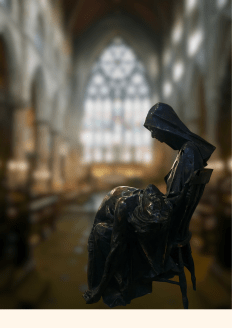
Here, the mother sits on a simple chair holding the completely broken body of her son, one side in light and the other in deep shadow. She holds him and stares into his face as the grief comes off her in waves. It is an image of utter desolation as a mother cradles the entirely broken body of her son. It is a moment when she is absolutely, totally alone and no one is singing, “Gloriana!” There are no angels or shepherds in this image, no manger and no promises of a future. There is only brokenness and grief, not even being able to comprehend what the future might hold. She is still, holding her silent, broken child.


In that moment, she wasn’t a saint to me, or a Blessed Virgin, or a Queen or any other of the triumphant images we have of her. In that moment, she was a mother who quietly grieved and in doing so, she understood my own pain. The fact that a future did in fact occur for both of us was irrelevant to that moment of deepest hurt. It was as though the mother, the ultimate Mother, stood beside me in shadow and whispered, “I understand.”
Now, when I think about Mary, I don’t think about an icon, or a representative figure of perfect motherhood; instead I think about a woman who agreed to take on a journey when she didn’t really know how much pain would be involved, even as this was woven together with joy and of a woman who was there from beginning to end – no matter what – even and perhaps especially when the unexpected occurred. I realised that now, I feel a much deeper connection to Mary the woman, Mary the mother, Mary the warrior, than I ever used to do. I don’t worship her and I never will, but I do feel a deep affinity with her and sometimes I ask her to pray for me.
Edit: If you’re interested in exploring more about Mary, as she is presented in different ways to the more popular Roman Catholic tradition, consider starting with Nicola Slee’s “The Book of Mary”.
 Life In Holland